Seventh sense

The Seventh Sense is the vestibular system. This is the movement and balance sense. The vestibular system is located in the inner ear, specifically in the vestibular labyrinth. It plays an important role in balance, spatial orientation, and coordinating movement. The brain integrates the information it receives from the vestibular system with the sight sensory, proprioception, muscles and joints; and this informs the brain to send signal to the body to maintain in balance and coordinate movements.
This sensory system is responsible to assist with balance, coordination, body-position changes. It also assists with orientation of a person as well as detection of moving objects in a space in relation to the person.
The vestibular system is divided into two systems:
Peripheral vestibular system: There are five organs in the inner ear that sense information the body needs to maintain balance such as posture, position and movement.
Central vestibular system: One of the functions of the central nervous system (CNS) is to process balance signals that are sent from the vestibular organs in the inner ears.
The two primary reflexes that allow the vestibular system to work closely with sight sense, joints and muscles are:
Vestibulo-ocular reflex (VOR): The vestibular system and sight sense coordinate in order to maintain gaze even when the body is in motion. This helps with orientation.
Vestibulospinal (VS) reflex: The muscles adapt to the information received from the vestibular system. The muscle changes in the body informs the vestibular system. The VS reflex causes the muscles to move in response to body movement.
The vestibular system is located in the inner ear’s vestibular labyrinth. There are five vestibular organs that sense the head’s position and send nerve signals to the parts of the brain to help with body balance. The five organs are three semicircular canals and two otolith organs (utricle and saccule). The vestibular labyrinth contains a fluid called endolymph and tiny hair cell sensory receptors, stereocilia. As the head moves, the endolymph shifts. In turn, the stereocilia shifts. This nerve signals travel via the vestibular nerve to the brain to inform it and the body’s location and movement.
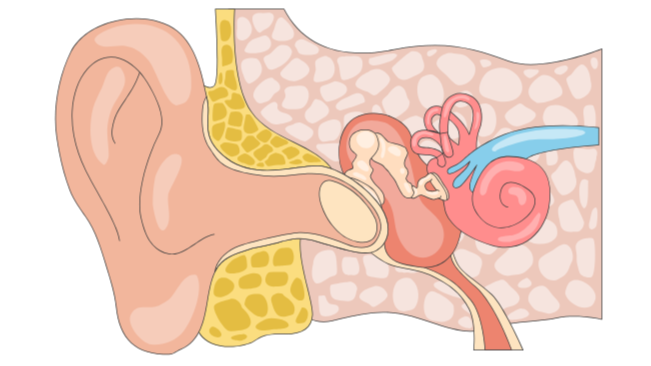
The semicircular canals end in a structure called an ampulla. The ampulla contains stereocilia that extends into a gelatine-like substance called cupula. When the head moves, the endolymph within the semicircular canals shifts, causing the cupula to move and bend the stereocilia. The stereocilia movement triggers the release of nerve signals to the brain to inform its position. The semicircular canals help maintain balance and equilibrium by sensing head movements and providing feedback to the brain. This then triggers body compensatory movements to maintain stability.
The otolith organs’ function is to detect linear movement and gravitation. They are
Utricle: detects horizontal movement
Saccule: detects vertical movement
These organs are house structures called the macula. The macula has stereocilia that extend into a gelatine-like substance which are filled with calcium-crystals called otoconia. When a person moves, these otoconia shifts with the stereocilia, and convert mechanical movements into neural signals that are sent to the brain.
There is abundant evidence for both structural and functional hearing deficits in ASD. These findings are consistent with key signs and symptoms, specifically that individuals with ASD appear unaware when people talk to them, but respond to non-verbal sounds, repeat words or phrases in place of normal speech and have abnormal reactions to sensory stimulation (CDC.gov, 2021). (1)
Autism spectrum disorder (ASD) is a neurodevelopmental disorder characterised by repetitive behaviours, poor social skills, and difficulties with communication. Beyond these core signs and symptoms, the majority of subjects with ASD have some degree of auditory and vestibular dysfunction.
Dysfunction in these sensory modalities is significant as normal cognitive development depends on an accurate representation of our environment. The hearing difficulties in ASD range from deafness to hypersensitivity and subjects with ASD have abnormal sound-evoked brainstem reflexes and brainstem auditory evoked potentials. Vestibular dysfunction in ASD includes postural instability, gait dysfunction, and impaired gaze. Untreated vestibular dysfunction in children can lead to delayed milestones such as sitting and walking and poor motor coordination later in life. Histopathological studies have revealed that subjects with ASD have significantly fewer neurons in the auditory hindbrain and surviving neurons are smaller and dysmorphic.
These findings are consistent with auditory dysfunction. Further, the cerebellum was one of the first brain structures implicated in ASD and studies have revealed loss of Purkinje cells and the presence of ectopic neurons.
Together, research has suggested that normal auditory and vestibular function play major roles in the development of language and social abilities, and dysfunction in these systems may contribute to the core symptoms of ASD. Furthermore, auditory and vestibular dysfunction in children may be overlooked or attributed to other neurodevelopmental disorders. Herein we review the literature on auditory and vestibular dysfunction in ASD. Based on these results we developed a brainstem model of central auditory and vestibular dysfunction in ASD and propose that simple, non-invasive but quantitative testing of hearing and vestibular function be added to newborn screening protocols. (2)
Children with autism spectrum disorder (ASD) not only have communication and social difficulties, but also exhibit poor balance and motor control ability, which frequently affect daily activities. Effective balance and motor control rely on the integration of somatosensory, visual, and vestibular inputs. Although reports of balance dysfunction in ASD have been documented, comprehensive studies of balance and vestibular function in children with ASD are scarce. From the study by Oster and Zhou (3), they retrospectively reviewed 36 children diagnosed with ASD who underwent balance/vestibular laboratory testing in their speciality clinic. Results from sensory organisation test (SOT) or modified clinical test for sensory integration of balance (mCTSIB) found that out of 15 patients, 80% had abnormal findings. Of the children who successfully completed each vestibular test, abnormal responses were observed in 12 (80%) sensory organization tests, 5 (24%) vestibular evoked myogenic potential (VEMP), 22 (66%) videonystagmography (VNG), and 11 (32%) sinusoidal rotary chair tests. These results indicate that balance and vestibular testing may be of diagnostic value for clinicians and providers as an aid in early detection, intervention, and the development of appropriate management and therapies for these children. Increased awareness of this topic is warranted to promote better clinical management of these children and improve their quality of life. (3)
References:
Mansour, Y., Burchell, A., & Kulesza, R. J. (2021). Central auditory and vestibular dysfunction are key features of autism spectrum disorder. Frontiers in Integrative Neuroscience, 15, 743561.
Mansour, Y., Burchell, A., & Kulesza, R. J. (2021). Central auditory and vestibular dysfunction are key features of autism spectrum disorder. Frontiers in Integrative Neuroscience, 15, 743561.
Oster, L. M., & Zhou, G. (2022). Balance and vestibular deficits in pediatric patients with autism spectrum disorder: An underappreciated clinical aspect. Autism Research and Treatment, 2022, Article 7568572.